Filling a key position, whether internally or externally, is an investment in the company’s future. Each appointment is an opportunity to reassess the role’s expectations, including responsibilities, competencies, skills, authority, accountability, and make the role future-ready. Succession planning now focuses on building future capabilities to address uncertainty, rather than simply replacing personnel.
My article explains why and how to do it, with concrete examples and challenging questions to ask before we do so.

Macro shifts in succession planning
Succession planning itself has fundamentally changed in the last 3-5 years.
We have witnessed it evolve from a static annual HR exercise into a continuous strategic capability-building process. Leadership gaps are now more costly due to the market’s speed and volatility. 86% of leaders see it as critical, but only ~14% do it well*.
‘Skills-first’ models – slowly but surely – are overtaking credential-based pipelines. AI is reshaping jobs faster than job descriptions can keep up. CEOs are starting to ask, for example, “What capabilities must exist in the CFO function?” instead of “Who will replace the CFO?”
AI is not taking the leader’s job – the job doesn’t disappear – it shrinks in some areas and expands in others. Because of this, succession planning should consider how well candidates can use AI, not just their experience.
The successor problem CEOs don’t see coming
I will walk you through how three key leadership roles have changed over time. These are just general examples. Keep in mind that the final role can shift in response to changes in industries, new technologies, upcoming regulations, evolving customer needs, and AI.
Chief Finance Officer
Three years ago, a European mid-sized manufacturing company promoted its long-serving Head of Finance to CFO. It was the logical choice. He was technically flawless, loyal, and trusted.
The company had invested heavily in automation, entered two new markets, and faced volatile energy pricing. What it needed was not control, but foresight.
Eighteen months later, the CEO realized something unsettling: The CFO could explain the past in perfect detail but could not model the future. What it had built was not a successor pipeline, but a legacy pipeline.
The company had to redefine the CFO role after a failed transition and replaced the CFO with an external candidate.
Chief Operating Officer
At a food production company, the Head of Operations seemed like the obvious choice to become COO. With 20 years of experience and strong process knowledge, he was well prepared.
But later, as the company faced supply chain disruptions, climate change, shifting customer needs, and new automation, the role changed in unexpected ways.
He now had to use predictive analytics in production, manage risks beyond efficiency, and balance sustainability with profits. However, the internal candidate kept focusing on process optimization rather than adapting to these new demands.
Operations shifted from focusing solely on efficiency to building resilience and adaptability amid uncertainty. The CEO learned that it was better to focus on flexible systems rather than rely on stable processes.
Chief Information Officer
In many organizations, the CIO has evolved from a back-office service provider to a strategic power role. This shift became clear at a financial services company that learned the importance of the CIO the hard way.
Their internal successor was technically exceptional, ensured system stability, and delivered projects on time. But he failed to influence business strategy, translate technology into competitive advantage, and shape AI adoption.
Recognizing the need for strategic leadership, the CEO eventually redefined the role from a support function (run IT) to a business transformation engine (run transformation). This shift made it clear that the original assessment of the role change was neither thorough nor conducted in advance. The selected successor was merely a specialist.
The illusion of continuity
Many succession plans rely on a hidden assumption: “The future will reward the same strengths that made people successful in the past.” But this idea no longer holds true.
Most CEOs still see succession planning as a matter of continuity. They ask, Who has the right experience? Who is ready? Who could step in within one or two years? Today, these questions miss the mark because the roles are changing faster than your plans can keep up.
New way of role assessment
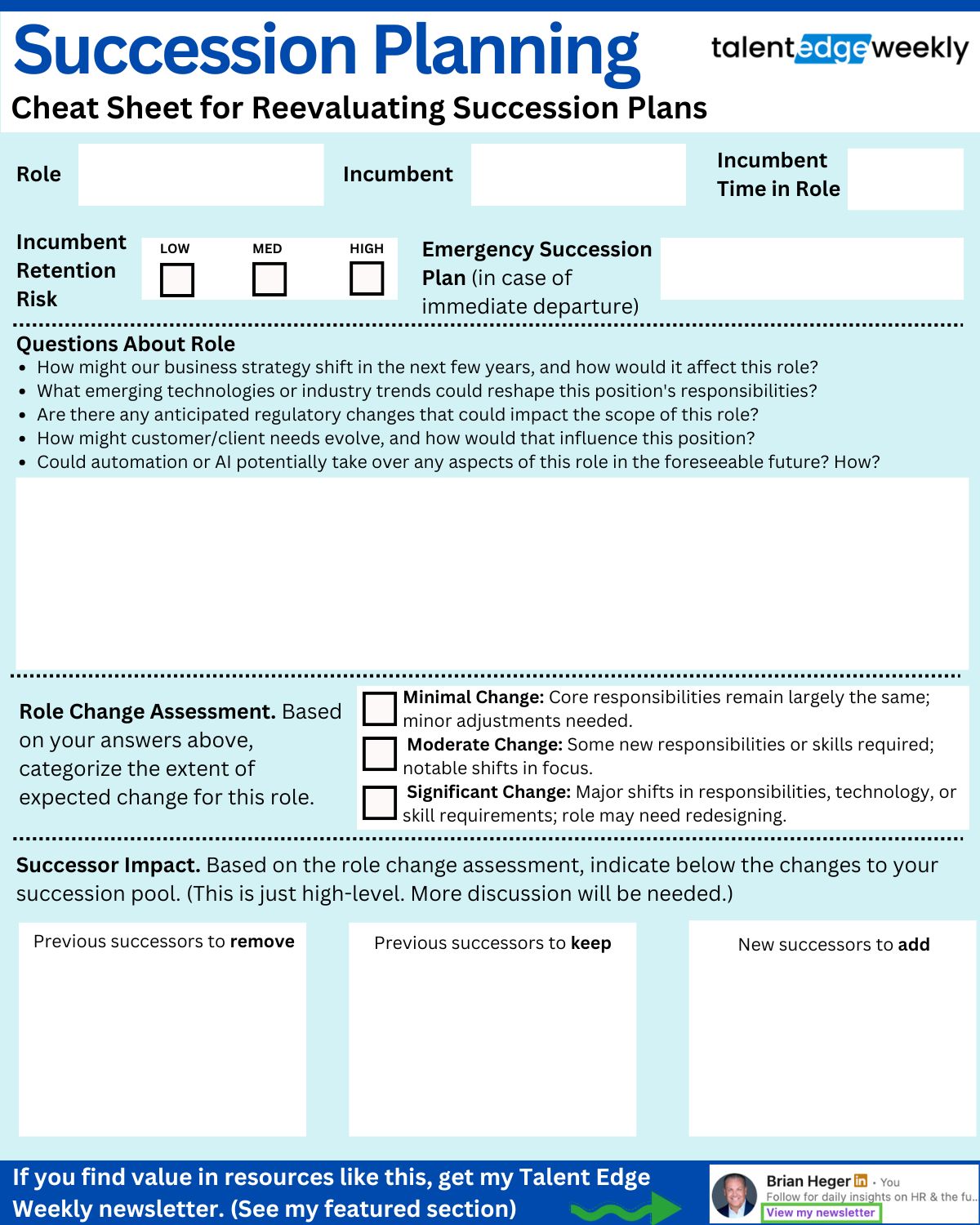
I found a helpful resource called “Cheat Sheet for Reevaluating Succession Plans” by Brian Heger**. You can download it from the attachment. It is worth following Brian on LinkedIn and subscribing to his newsletter.
He has rethought the role assessment and added new questions:
- How might our business strategy shift in the next few years, and how would it affect this role?
- What emerging technologies or industry trends could reshape this position’s responsibilities?
- Are there any anticipated regulatory changes that could impact the scope of this role?
- How might customer/client needs evolve, and how would that influence this position?
- Could automation or AI potentially take over any aspects of this role in the foreseeable future? How?
Based on the answers above, CEOs and CHROs can categorize the expected change for this role:
- Minimal change: Core responsibilities remain largely the same; minor adjustments needed.
- Moderate change: Some new responsibilities or skills required; notable shifts in focus.
- Significant change: Major shifts in responsibilities, technology, or skill requirements; the role may need to be redesigned.
Finally, they can indicate the changes to the succession pool:
- Previous successors to remove
- Previous successors to keep
- New successors to add
The role assessment questions can be further refined with questions such as: What capabilities must exist in this role in 3–5 years? Where are we over-indexing on past success profiles? Who is already growing into that future, even if they are not the obvious choice?
Final thoughts
Succession planning is evolving from simply replacing leaders to building future-ready organizational capabilities.
The greatest succession planning risk is not a lack of successors, but having individuals prepared for a world that no longer exists.
Sources: *Deloitte: The holy grail of effective leadership succession planning 2018, **Brian Heger: Cheat Sheet for Reevaluating Succession Plans