This year brought a quiet revolution to the business and consulting world. It didn’t happen overnight, and it didn’t come with big headlines. But if you really paid attention, you could feel the ground move.
I certainly did. And I want to share what I’ve observed, because the shift in HR consulting is not just interesting. It’s defining the next decade of work.

The Shift in HR Consulting
HR consulting is changing fast — faster than many expected. And it’s not a single trend driving it, but a mix of forces reshaping how companies operate and what they need from their advisors.
Workforce transformation: People are working differently. More and more people are choosing flexible careers — fractional roles, portfolio careers, part-time executive work. AI has become a daily tool, not a faraway concept. It is all happening as the available talent pool shrinks, populations age, and employees feel less attached to their organizations. Employees want options. Organizations want resilience. And HR consulting must help bridge the two.
Business models are changing: Companies no longer want thick manuals and rigid processes. They want to move quickly. They want to partner, co-create, experiment, and adapt. Hierarchies are loosening; ecosystems are forming. Today’s consulting is not about strengthening the old operating model — it’s about helping clients build one that can flex in real time.
Technology is advancing faster than the playbooks: Clients expect consultants to deliver technology-enabled solutions, not just recommendations. AI. Automation. Workforce analytics. Skills platforms. Digital talent marketplaces. If an HR consultant can’t speak the language of tech, they can’t talk to the future.
Leadership is shifting too: The leadership skills that worked for the last 30 years won’t carry us into the next 10. Relational intelligence, systems thinking, and the ability to lead change — these are becoming must-haves. HR consulting is shifting from “let’s fix the people” to “let’s reinvent how leadership works in this system.”
Clients expect measurable value: The era of “nice-to-have HR programs” is over. CEOs want to see business value – revenue, productivity, risk reduction, customer experience – not just polished HR KPIs. Modern HR consulting must deliver impact that shows up on the business dashboard.
Traditional vs. Modern HR Consulting
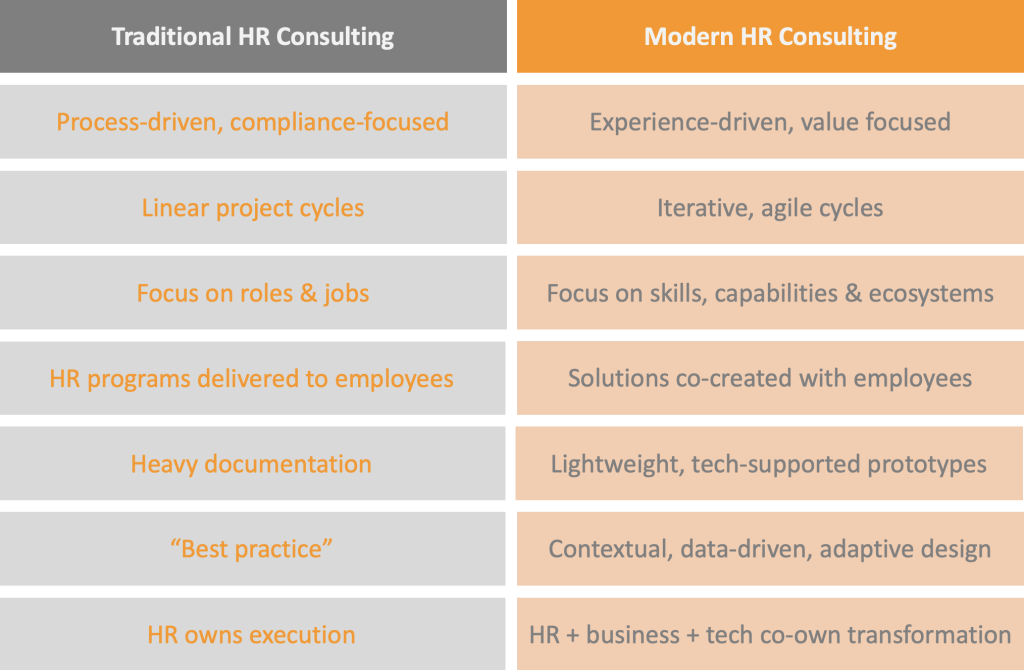
For years, traditional HR consulting was about stability: policies, processes, job descriptions, compliance, and documentation. It was necessary — but not particularly dynamic. Modern HR consulting feels completely different.
It helps companies build flexible, skills-driven, tech-enabled ways of working that can adapt quickly to a changing world.
Put simply, traditional HR consulting created frameworks for HR teams and organizations, while modern HR consulting works with leaders and teams, using data and technology to develop business solutions.
To make this easier to follow, please find a table below:
The Critical Topics Shaping Modern HR Consulting
For the time being, these are the areas where clients need help the most and where HR consulting is evolving into an acknowledged strategic partnership:
- Leadership reinvention: New models and mindsets (focus on systemic, adaptive, and transformative leadership), shaping culture, and acquiring new relational leadership abilities.
- Organizational agility: Use networked structures, flexible work models, and cross-functional teams.
- Workforce ecosystem strategy: Bring together full-time staff, gig workers, partners, AI, and automation.
- AI-augmented work design: Use co-pilots, manage automation, and rethink roles and workflows.
- Culture & change operating systems: Shift from one-time change management to building an ongoing change infrastructure.
- Employee Experience & productivity science: Use real-time analytics, productivity checks, behavioral data, and targeted interventions.
- Skills & capability architectures: Build dynamic skills databases, learning academies, and talent marketplaces.
- Trust, Ethics & Workforce Risk: Uphold data ethics, support psychological safety, and manage talent risks.
Modern HR Consulting Creates Real Value
Modern HR consulting offers several ways to help businesses succeed.
For example, HR consulting can boost productivity by redesigning work and how it gets done; grow revenue by improving the workforce’s customer-facing skills; accelerate transformation through an agile organizational structure and an adaptive culture; and strengthen innovation by building skills-driven, diverse teams.
It also helps retain top talent through systemic, adaptive, or transformative leadership, and can lower labor costs by optimizing the workforce mix.
This is HR as a value creator, not a cost center.
Future-Critical Skills for HR Consultants
Tomorrow’s HR consultants look very different from yesterday’s or even today’s. They need to build and improve their knowledge in four main areas.
To help you see the whole picture, please find a table below:
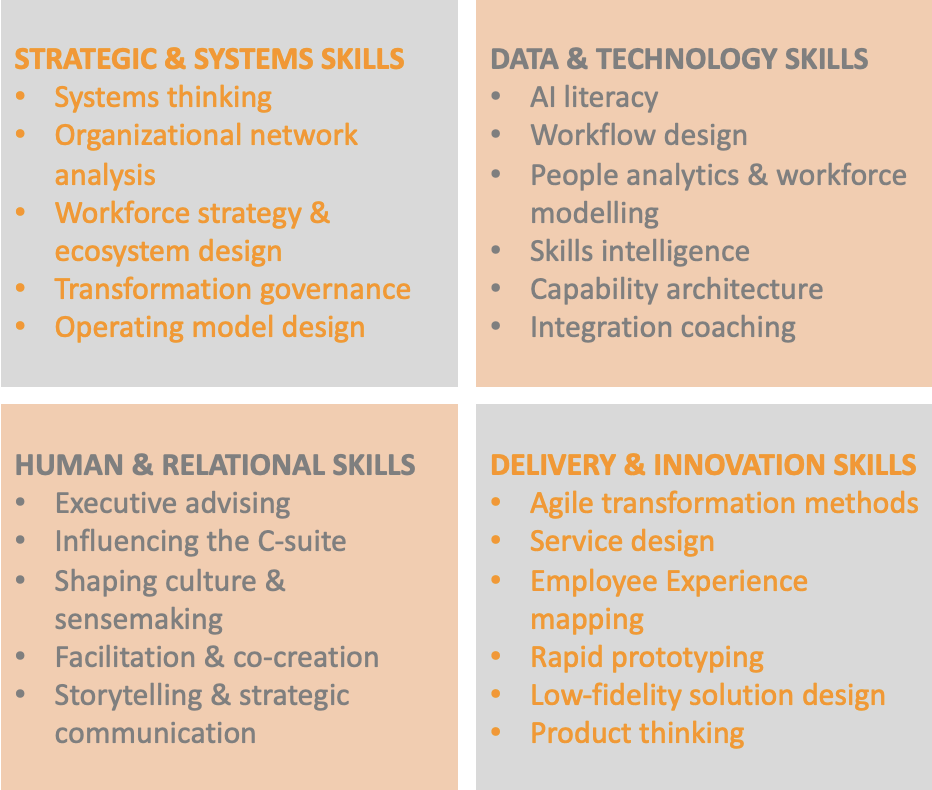
I hear you already saying, “OMG, there is so much to learn!” and it is true and almost impossible. Decide which area is close to your heart and where you already have significant knowledge and credible practices. So you can build on it and move quickly with the adaptation. Or team up with other product/service providers and consulting firms to co-create tailored-made solutions to complex needs.
Where HR Consulting Is Really Headed
We’re living through a fundamental shift in HR consulting. Improving policies and processes is no longer enough, and CEOs know it.
CEOs want HR consultants who can help them reimagine their business capabilities, redesign work and workforce, and build agile organizations that learn, adapt, and evolve continuously. The companies that develop these new muscles – including curiosity, adaptability, system intelligence, and tech-enabled decision-making – will lead the next chapter of business.
Modern HR consulting is becoming a strategic engine for business transformation.
I drew on various sources and my own experience to write the article, and I also used Grammarly as a proofreading tool. Thank you for reading my article!