
“By 2035, half of your team will no longer be employees.” is not a threat; it is a business opportunity. Work is becoming a flexible, extended ecosystem. Future-ready leaders redesign how work gets done to enable sustainable growth.
On January 8, 2026, I had the opportunity to share insights on the evolving challenges and exciting opportunities within workforce ecosystems at CEONET, A KLUB in Budapest, Hungary. I am excited to bring you the session’s most valuable insights in this article.

The growth initiative that nearly failed
As a CEO, you have a critical growth initiative. The strategy is sound. The board supports it. The budget is approved. Yet the initiative can’t start. Not due to funding or technology, but because the required capabilities are missing in the organization. Hiring would take nine months. The market opportunity lasts six. You cannot hire your way through every project, change, or transformation. The real constraint is talent scarcity and a traditional workforce model.
Talent & Workforce Design Challenges
Rapid change and mounting crises have turned traditional employment-based organizations into slow-moving, inflexible, and increasingly risky structures. CEOs and Board members are captivated by this issue, as talent shortages and flawed workforce design can stall strategy, slow growth, erode control, and diminish enterprise value.
So, what is the answer to this pressing challenge?
A Strategic Shift Toward a Workforce Ecosystem
The work is evolving. Technology enables access to the workforce globally. Work is becoming more flexible, unpredictable, collaborative, value-focused, and non-routine. Jobs are fading away and becoming irrelevant. Skills-based design replaces it.
The workforce is changing, too. People want to determine what, where, when, how, and with whom to work. They focus on interesting challenges, productivity, and value creation with others. They want to commit less to companies as employees.
CEOs and Board members strive to ignite growth, outpace rivals, fuel innovation, and anchor stability to thrive amid the rapid pace, complexity, and volatility of today’s business world. To reach these ambitious goals, organizations are moving away from traditional organizational models and embracing workforce ecosystems. But what exactly is a workforce ecosystem?
A Workforce Ecosystem is a structure that includes participants from both inside and outside the organization who collaborate to create value. These participants pursue individual and collective goals, serve diverse customers, and operate within interdependent, complementary relationships.
Intriguing, but how does a workforce ecosystem actually take shape?
Features of Workforce Ecosystem
At its heart, the workforce ecosystem is about managing the entire talent landscape, far beyond just full-time employees, by coordinating diverse actors with varying levels of autonomy to meet strategic objectives.
Key Components
- Internal Workforce: Traditional employees
- External Talent: Freelancers, gig workers, short-and long-term contractors, subcontractors, vendors, professional service providers, application developers, accessory providers
- Partners & Customers: Other organizations, crowdsourcing participants, and even customers playing collaborative roles
- Technology: Chatbots, AI, automation, robots, and software as participants or enablers
A well-designed workforce ecosystem enables rapid adaptability to market shifts, unlocks specialized expertise to achieve strategic goals, and accelerates innovation through collaboration.
But we already do this, don’t we? Let’s see!
Traditional external cooperation vs. workforce ecosystem
While traditional external cooperation is transactional and fragmented, the workforce ecosystem is strategic, integrated, and governed as one system.
It is a logical move…
- from transactional buying (services, capacity, focus on cost/delivery) to system design (leaders design how work flows in blended teams),
- from fragmentation (no one owns the whole picture) to integration (all contributors are part of the workforce system, centralized governance, flexible execution),
- from roles and contracts to tasks, outcomes, and capabilities,
- from cost control (reduce costs, fill gaps temporarily) to values and speed (time-to-capability, strategic resilience, scalability without structural risk, innovation speed),
- from peripheral (externals handle “non-core” activities) to core work (externals may deliver core, high-value work),
- from control via detailed contracts and oversight to control via governance (clear decision rights, data and access rules, outcome metrics, ethical and individual property guardrails).
This is no longer about managing employees; it’s about designing and governing a workforce system.
Let’s learn more about what hidden risks lie within the workforce ecosystem.
Business opportunity with risk
The workforce ecosystem can fail to support change or transformation for the following reasons: organizational silos, an inadequate leadership style can cause leaders to lose relevance, insufficient or inefficient technology, underinvestment in the workforce ecosystem, cultural breakdown (disintegration), psychological constraints, excluding external talent, partners, and customers from planning and development, fairness, data-protection, and access problems, legal and IP risks, missing robust governance.
Shifting to the workforce ecosystem is a business opportunity with both short- and long-term strategic, financial, leadership, legal, operational, and technological risks.
How should leadership adapt to the new structure?
Leadership capabilities’ alignment
Leadership capabilities align with a workforce ecosystem when leaders shift from managing people and roles to designing, orchestrating, and governing how work gets done across employees, external contributors, and technology.
Leaders must be able to decompose work into tasks and outcomes, decide the right mix of human, external, and technology contributions, and take accountability for results without relying on formal authority or long-term employment.
Leaders need strong systems thinking and the discipline to codify decision rights, performance standards, and ethical boundaries so that culture and control are built into the operating model.
Leadership in a workforce ecosystem requires comfort with ambiguity and speed: leaders must continuously rebalance the workforce portfolio, learn from experiments, and adapt the system as skills, technology, and markets evolve.
Now it is time to share some business practices.
Business practices
A workforce ecosystem approach is increasingly mainstream in global business. Many large corporations – including Novartis, PayPal, Siemens, Cisco Systems, Unilever, Microsoft, WPP, Adobe, HP, Salesforce, Mastercard, Workday, Remote, SAP Fieldglass – are already experimenting with or operationalizing ecosystem design to improve agility, access to critical skills, and scalability in volatile markets.
These companies extensively use external freelancers, contractors, strategic vendors, open-source communities, AI copilots, and agents embedded in workflows. Teams are outcome-based, not role-based.
They use an internal talent marketplace focused on projects instead of roles, plug external experts into teams, and let employees move fluidly across assignments. Skills visibility replaces job titles.
Smaller companies like Applause are also experimenting with a workforce ecosystem. Applause keeps a small control organization while building and managing a large digital community. By integrating internal and external contributors, Applause provides services beyond what is typical for an organization of its size.
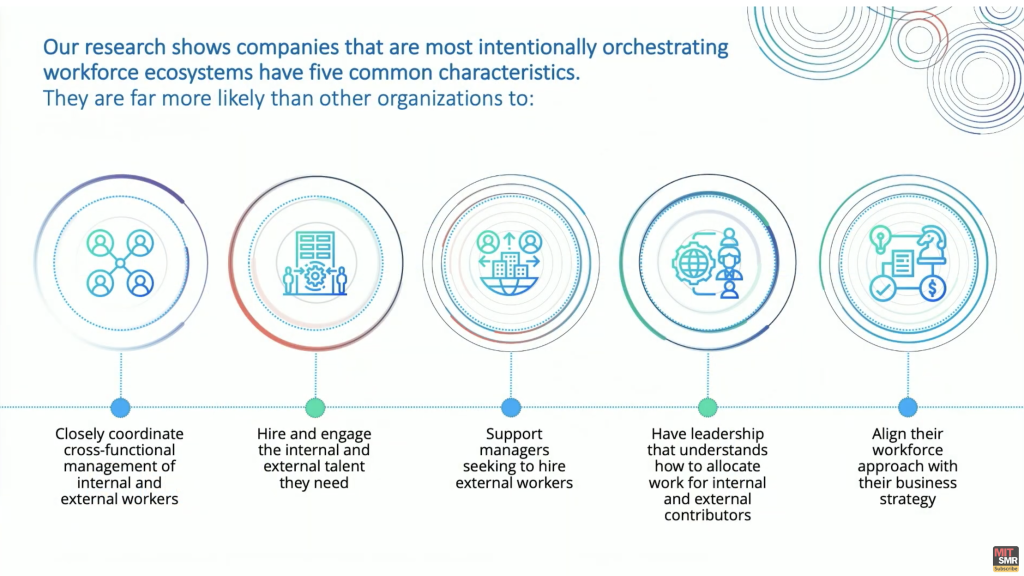
The illustration below shows the 5 common characteristics of companies that use a Workforce Ecosystem. (Source: Orchestrating Workforce Ecosystems by MIT Sloan Management Review)
Start Replacing Traditional Structures
Replacing the traditional workforce ecosystem starts with a thorough internal analysis. This includes critical capability dependency risks, hidden work outside formal roles, AI displacement vs. augmentation potential, the cost of permanence vs. flexibility, leadership readiness or failure points, legal exposure across geographies, and cultural breakpoints.
Let’s see what your takeaway is!
Final thoughts
Companies want to scale for growth without structural risk, deliver business value, and achieve execution speed in a fast, complex, volatile business environment.
An external talent pool can offset an internal talent shortage.
Companies do not replace employees. Instead, they redesign how work is delivered, governed, controlled, and scaled through the right mix of employees, external talent, and technology.
The question is not whether companies will implement a workforce ecosystem, but whether it will happen in a conscious, planned, step-by-step way or in a reactive, risky way.